KRAS Mutant CDX Models
CHARACTERIZED AND READY FOR YOUR NEXT STUDY
Subcutaneous growth data for 27 TD2 cell line–derived xenograft models spanning the major KRAS alleles, with standard-of-care benchmarks for treatment-response context.
26
KRAS-mutant models, plus a wild-type reference (BxPC-3)
7
KRAS alleles: G12D, G12V, G12C, G13D, G12S, Q61H, Q61K
6
Indications: pancreatic, lung, colorectal, endometrial, biliary, breast
4
Host strains: athymic nude, ICR SCID, NSG and huNSG
TD2’s panel of 27 cell line derived xenograft (CDX) models covers the KRAS mutations behind pancreatic, lung, colorectal, endometrial, biliary and breast cancers. Twenty-six models are KRAS-mutant, spanning G12D, G12V, G12C, G13D, G12S, Q61H and Q61K, and one, BxPC-3, is a KRAS wild-type reference. Models are available across four host strains: athymic nude, ICR SCID, NSG and huNSG.Each model comes with in-house subcutaneous growth data and a standard-of-care response curve, so you can match allele and growth rate to your study design and set your dosing window with confidence.
Models by KRAS Allele
| Allele | Models | Cell lines |
|---|---|---|
| G12D | 9 | AsPC-1, HPAC, HPAF-II, PANC-1, SU.86.86, A427, LS174T, HEC-1-A, HuCCT-1 |
| G12V | 7 | Capan-1, Capan-2, PA-TU-8988S, PA-TU-8988T, NCI-H441, SW480, SW620 |
| G12C | 3 | MIA PaCa-2, NCI-H23, NCI-H358 |
| G13D | 4 | HCT116, HCT-15, LoVo, MDA-MB-231 |
| G12S | 1 | A549 |
| Q61H / Q61K | 2 | Calu-6, NCI-H460 |
| Wild-type reference | 1 | BxPC-3 |
Don’t see your cell line or your indication? Tell us the target and we will tell you what what we can source, and how long it takes to characterize.
Learn more about our KRAS-mutant CDX Models
Example Growth and Response Data From the Panel
Two examples from the panel. One shows a G12C model cleared by a RAS-targeted inhibitor, the other shows a G12D model against the pancreatic standard of care.
Figure 1: MIA PaCa-2 Pancreatic Xenograft Growth in Athymic Nude Mice
Subcutaneous growth: Vehicle vs Daraxonrasib (n = 8/group)
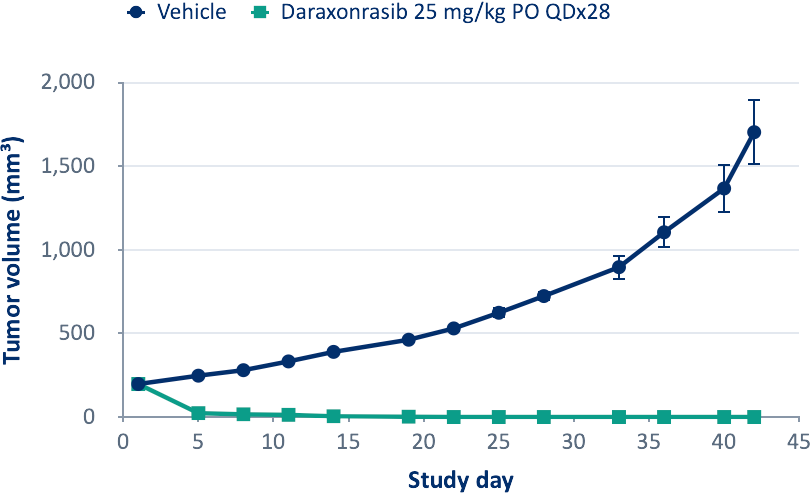
MIA PaCa-2 (KRAS G12C, pancreatic). Athymic nude mice, n = 8 per group. Daraxonrasib (RMC-6236) 25 mg/kg PO QDx28 versus vehicle. Control tumors reached 1,703 mm³ by day 42. Treated tumors regressed to a 0% T/C.
MIA PaCa-2 is the model we reach for when a program needs to show a RAS-targeted agent doing what it claims. The response is complete and reproducible across our studies, which makes it a clean positive control for a novel G12C or pan-RAS inhibitor.
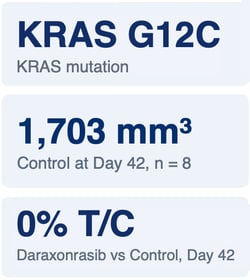
Model Details
Cell line: MIA PaCa-2
Indication: Pancreatic
KRAS: G12C
Host: Athymic Nude mice
Figure 2: HPAF-II Pancreatic Xenograft Growth in Athymic Nude Mice
Subcutaneous growth: Vehicle vs Gemcitabine + Abraxane (n = 10/group)
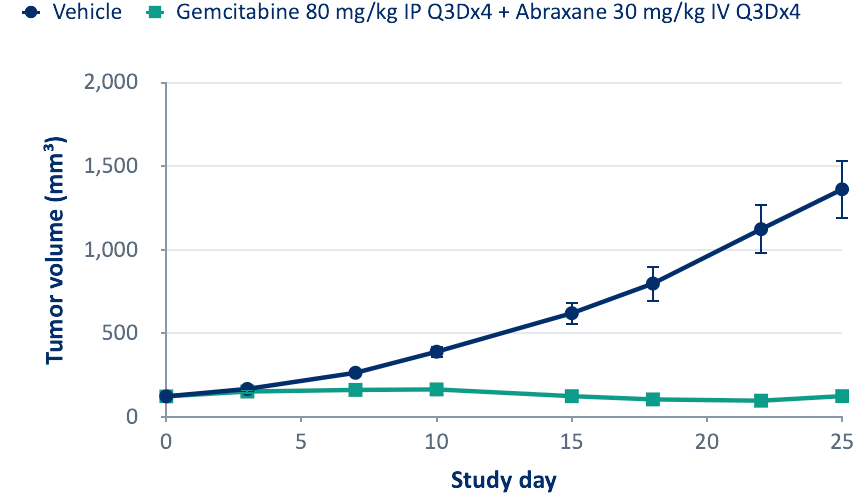
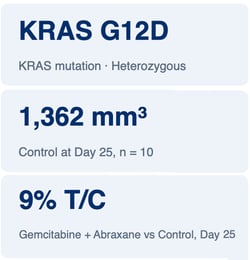
HPAF-II (KRAS G12D, heterozygous, pancreatic). Athymic nude mice, n = 10 per group. Gemcitabine 80 mg/kg IP Q3Dx4 plus Abraxane 30 mg/kg IV Q3Dx4 versus vehicle. Control tumors reached 1,362 mm³ by day 25, with a 9% T/C in the treated arm.
HPAF-II is the G12D workhorse. Growth is steady and the spread between animals is tight, so randomization lands where you expect it to and you need fewer mice to see an effect. It also gives you the gemcitabine and Abraxane benchmark every pancreatic program eventually gets asked for.
Model Details
Cell line: HPAF-II
Indication: Pancreatic
KRAS: G12D
Host: Athymic Nude mice
Complete KRAS Program Support
A growth curve is rarely the whole study. Most KRAS programs come to us needing an orthotopic model to confirm the subcutaneous result, PK/PD to explain it, or an immune-competent setting to test a combination. All of it runs under one team, so the data arrives in one package instead of three. Here is the full range of preclinical services available alongside any model in the panel:
- Orthotopic and Imaging tumor models
- DMPK/ADME
- In vitro Pharmacology Assays
- Syngeneic mouse models
- Flow Cytometry
- Metabolomics and Proteomics Analysis
- Non-GLP Safety/Tolerability
- Diet-Induced Obesity Tumor Model
Not sure what the full package looks like? Tell us the target and we’ll scope it.
FAQs
WHICH KRAS ALLELES DOES TD2 HAVE CDX MODELS FOR?
TD2 has cell line derived xenograft models for KRAS G12D, G12V, G12C, G13D, G12S, Q61H and Q61K, across 26 KRAS-mutant lines plus BxPC-3 as a wild-type reference. G12D is the deepest at nine models, followed by G12V at seven.
WHAT IS THE BEST XENOGRAFT MODEL FOR TESTING A KRAS G12C INHIBITOR?
MIA PaCa-2 is the most widely used KRAS G12C pancreatic xenograft model for inhibitor studies, and TD2 has in-house response data for it using daraxonrasib (RMC-6236) at 25 mg/kg PO QDx28, which drove tumors to a 0% T/C over 42 days. NCI-H358 and NCI-H23 are the two other G12C lines in the panel, both non-small cell lung cancer, which helps when you need activity in more than one indication.
WHICH MODELS CARRY KRAS G12D?
TD2 has nine KRAS G12D models: AsPC-1, HPAC, HPAF-II, PANC-1, SU.86.86, A427, LS174T, HEC-1-A and HuCCT-1. They cover pancreatic, lung, colorectal, endometrial and biliary cancer. HPAF-II is the usual starting point because its subcutaneous growth is consistent across animals and we have a gemcitabine plus Abraxane benchmark on file.
WHAT IS THE DIFFERENCE BETWEEN A CDX AND A PDX MODEL FOR KRAS WORK?
A CDX model uses an established cell line, so growth is predictable, the genotype is known and a study can start quickly. A PDX model uses patient tumor tissue and keeps more of the original tumor architecture, but takes longer to establish and varies more between animals. Most KRAS inhibitor programs start with CDX models for potency and dose finding, then move to PDX for translational confirmation.
CAN THESE MODELS BE USED FOR IMMUNO-ONCOLOGY STUDIES?
Yes. TD2 runs these models on humanized NSG backgrounds for immuno-oncology and combination work, alongside athymic nude, ICR SCID and standard NSG hosts.
HOW QUICKLY CAN A STUDY START?
Every model in this panel is already in colony and characterized, so there is no sourcing or characterization lag. Send us your target and endpoints and we will come back with a start date.
GET STARTED
Tell us the allele. We’ll tell you the model.
Send us your target, your indication and your endpoints. You will get back a model recommendation with the growth data behind it, a study design and a timeline. No discovery call required first.